
The 60-second answer
Unity 7 is real, but most of its headline capabilities are still forward-looking. Treat the announcement as a roadmap and preparation signal, not as a production upgrade instruction.
Confirmed, roadmap, vendor claim, or unknown?
The announcement mixes present facts with planned capabilities. Keeping those states visible prevents a roadmap sentence from turning into an engineering assumption.
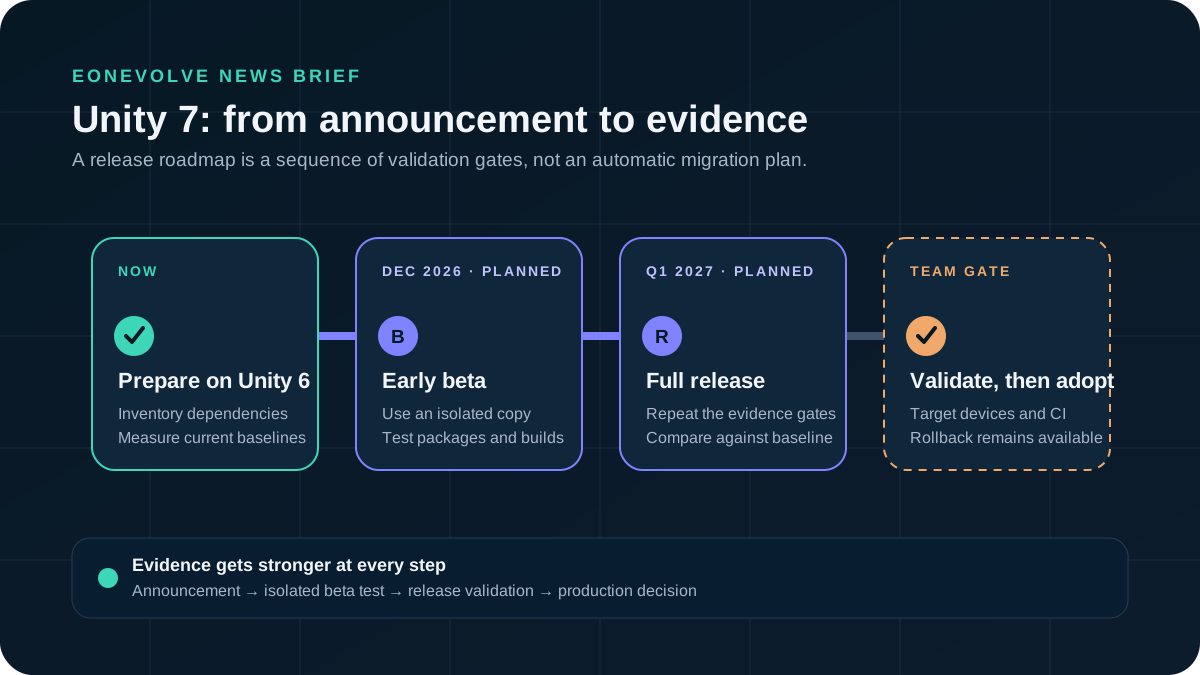
A useful release timeline
The safest interpretation is a sequence of evidence gates. Each later step needs stronger project-level proof than the step before it.
What Unity says will change
The announcement groups Unity 7 around five pillars. Four affect daily development or shipping directly; the fifth is the promised continuity layer underneath them.
What a Unity team should do now
Preparation should make the future test cheaper without making today's project depend on an unreleased editor.
Why the MCP announcement matters for game development
A game project is more than code files. Scene hierarchy, components, assets, build settings, console state, and Editor state all influence the answer to a development question.
From code-aware to project-aware assistance
Unity describes an MCP server as a bridge that lets compatible AI tools access project context such as scene hierarchy, code, and Editor state. Its current Unity AI material also describes an official MCP server in the Unity AI Assistant package.
That does not make an agent automatically correct or safe. Useful integration still depends on narrow tools, bounded context, explicit write permissions, human approval points, deterministic tests, and a reviewable evidence trail.
Sources:Unity: MCP servers in game development explainedUnity: Unity AI beta
Continue into the learning graph
These existing lessons build the engineering habits that make future Unity 7 and MCP experiments safer and easier to evaluate.
Official sources
The brief uses Unity's own release, newsroom, and product material. Product plans can change, so open the source next to any decision that depends on timing or availability.
Update log
Meaningful corrections and roadmap changes are recorded here. The original publication date remains stable.