
Eonevolve Learning

Eonevolve News Brief

MCP goes stateless: what it means for Unity

Anthropic's 2026-07-28 Model Context Protocol spec replaces session handshakes with self-contained, stateless requests, adds mid-call confirmation (MRTR), header-based routing, cacheable list results, and stronger authorization, and formally deprecates Roots, Sampling, Logging, and the HTTP+SSE transport with a twelve-month window. For Unity and game-dev MCP tools, most of the impact is operational: existing tools should keep working, but anyone running their own server or gateway should check for stateful assumptions.

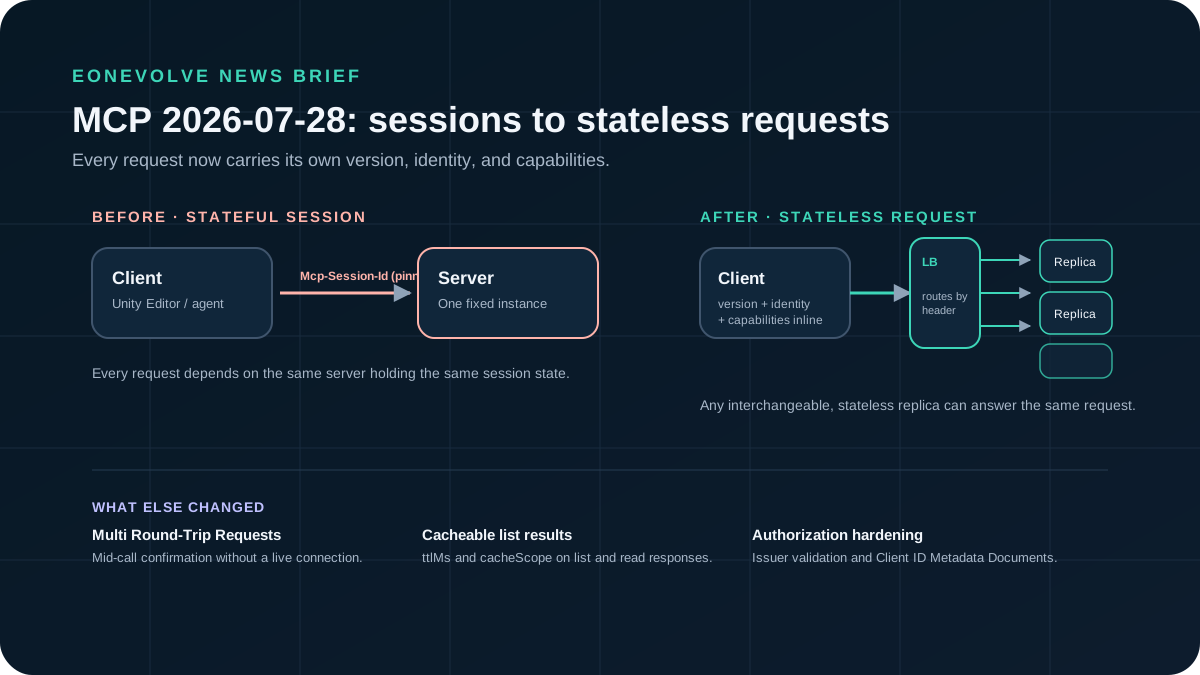
A before-and-after diagram showing a client pinned to one server through a stateful session, compared with a client whose self-contained stateless requests reach any replica behind a load balancer.
The 2026-07-28 Model Context Protocol specification replaces session-pinned connections with self-contained requests that any stateless server replica can answer.

The quick version

MCP 2026-07-28 at a glance

What shipped
A stateless protocol specConfirmed

No more session handshake or Mcp-Session-Id. Every request carries its own version, identity, and capabilities.

New capability
Mid-call confirmation (MRTR)Confirmed

A server can pause a tool call and ask for missing input without holding a connection open.

Also new
Header-based routing, cacheable lists, tighter authConfirmed

Gateways can route by header, list responses can declare a cache lifetime, and auth moves to Client ID Metadata Documents.

Deprecated
Roots, Sampling, Logging, HTTP+SSEConfirmed

Twelve-month minimum support window, so this is a planned migration, not a hard cutover.

Watch for
Rust SDK is still in betaRoadmap

TypeScript, Python, Go, and C# are Tier 1 now; Rust is not there yet.

Why this matters for Unity and game development

A Unity project is scene hierarchy, components, assets, build settings, and console output all at once. This release changes how reliably a tool can serve that context at studio scale, not what it is allowed to expose.

Unity's own MCP server already exposes scene hierarchy, components, and Editor state to compatible AI tools. This update mostly changes how dependably that connection runs across a whole studio, not what it exposes.

Three changes map onto real Unity work. Stateless requests mean a shared MCP gateway does not need sticky sessions across Editor instances or CI agents. MRTR gives a tool like applying a prefab override a real way to pause for a yes or no instead of assuming consent. Cacheable list results mean a tool that lists scene objects or build targets is not re-fetched on every turn.

What to do about it

If you run or build a Unity-facing MCP server

  • Check your transport, not just your SDK version

    An updated SDK can still run on the deprecated HTTP+SSE transport underneath.

  • Pilot MRTR on one tool that mutates a project

    An asset reimport or a prefab change is a good first candidate for a confirmation step.

  • Cache your slow-changing list tools

    Scene manifests and build-target lists are easy wins for ttlMs.

  • Give the 12-month deprecation window an owner

    Roots, Sampling, Logging, and HTTP+SSE do not need to move today, but someone should own the migration.

Keep learning

Related Eonevolve learning

Sources

Primary references

Update log

Article history

  1. Initial publication based on the Model Context Protocol 2026-07-28 release announcement and specification.